Square roots can feel like a whole new level of math. However, the concept simply reverses something we already know, which is squaring a number.
Squaring asks, "What do we get when we multiply a number by itself?" A square root flips the question and asks, "What original number got us here?"
Today, our Mathnasium tutors explain how square roots work, walk through methods for finding perfect square roots like prime factorization and repeated subtraction, and cover how to simplify non-perfect roots step by step.

What Is a Square Root in Math?
A square root is a number that produces the original number when multiplied by itself.
Let's use a simple example of squaring to see how this works.
We know that to square a number is to multiply it by itself. For example, 4 squared (42) is 4 × 4 = 16.
A square root reverses that process, and it asks the opposite question. What number, multiplied by itself, gives us 16?
The answer is 4, since 4 × 4 = 16.
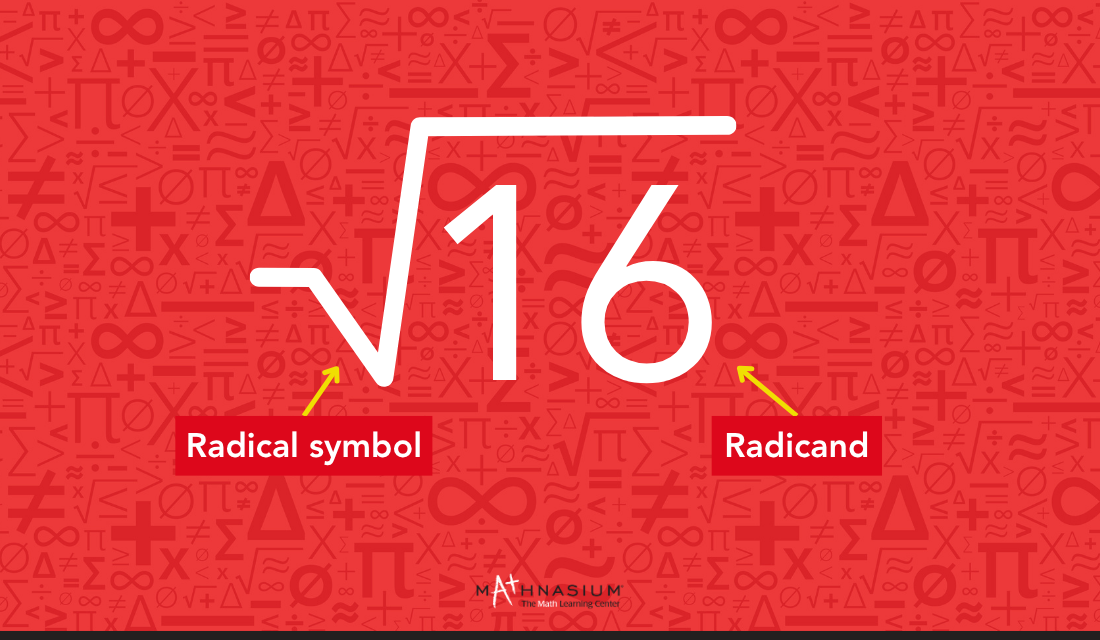
To write this mathematically, square root notation relies on two main components:
So \(\sqrt{16}\)=4 states that the square root of 16 is 4.
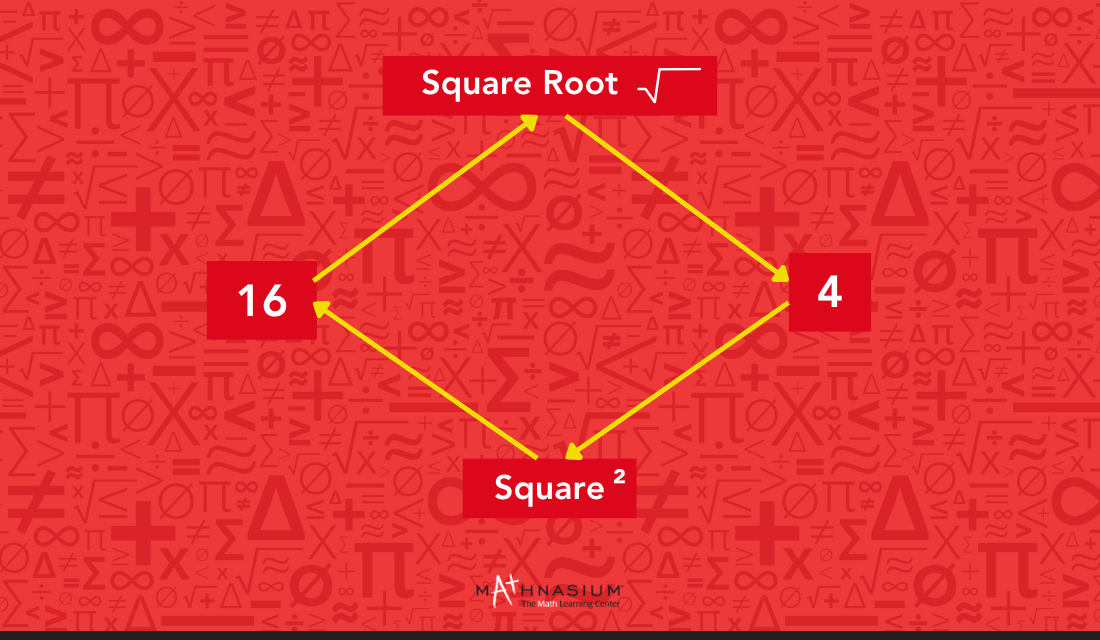
Square roots and squaring are inverse operations. One undoes the other, the same way subtraction undoes addition, or division undoes multiplication.
The diagram below shows how squaring and finding a square root connect and reverse each other.
Let's look at one more important detail.
(-4) × (-4) also equals 16, since two negative numbers multiplied together give a positive result.
So why does \(\sqrt{16}\)=4 and not -4?
Because the radical symbol always represents the positive answer, called the principal square root.
So even though both 4 and -4 square to 16, \(\sqrt{16}\) refers only to 4.
Squaring any number, positive or negative, always produces a positive result. That means no real number, when multiplied by itself, gives us -16. So negative numbers have no square root among the numbers we use in everyday math.

What Is a Square Root of a Perfect Square?
The square root of a perfect square is always a whole number, with no decimals or remainders left over.
That clean result comes from how a perfect square is built. It's the product of a whole number multiplied by itself.
Let’s use the number 9 as an example.
The square root of 9 is 3 because 3 × 3 = 9.
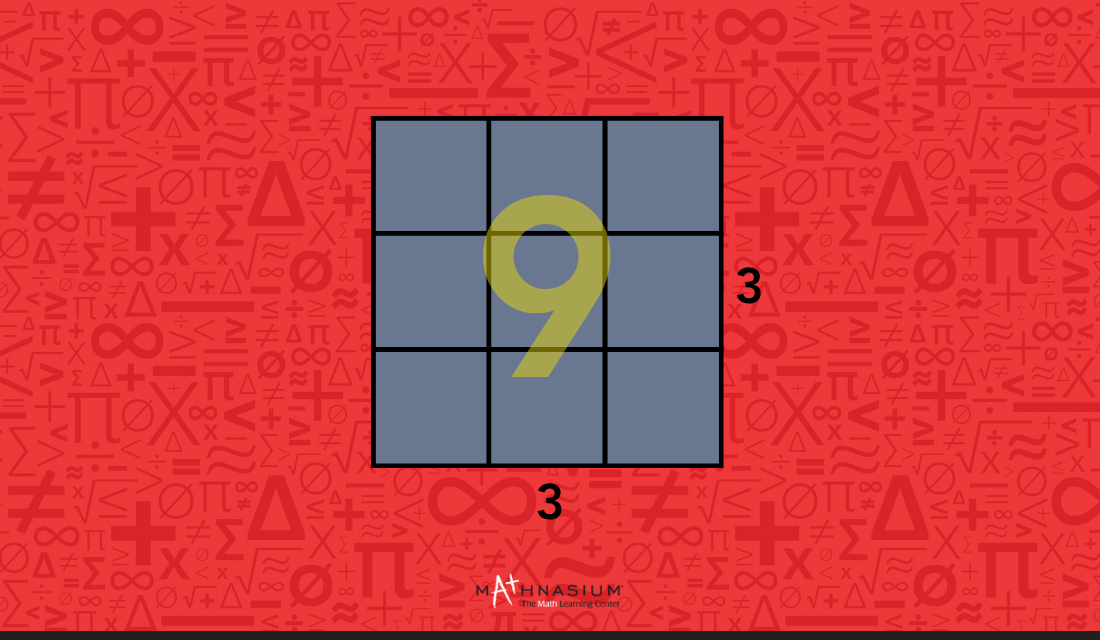
This relationship forms a square shape we can picture directly. A grid measuring 3 units wide by 3 units high holds 9 small squares in total.
The total area, 9, is the perfect square, while the length of a single side, 3, is its square root.
We speed up this process by learning to recognize perfect square roots on sight. In school, students are typically expected to memorize the square roots of perfect squares up to 144 (the roots from 1 through 12).
|
Number
|
Multiplication
|
Perfect Square
|
| 1 |
1 × 1 |
1 |
| 2 |
2 × 2 |
4 |
| 3 |
3 × 3 |
9 |
| 4 |
4 × 4 |
16 |
| 5 |
5 × 5 |
25 |
| 6 |
6 × 6 |
36 |
| 7 |
7 × 7 |
49 |
| 8 |
8 × 8 |
64 |
| 9 |
9 × 9 |
81 |
| 10 |
10 × 10 |
100 |
| 11 |
11 × 11 |
121 |
| 12 |
12 × 12 |
144 |
📕 You May Also Like: What Does “Squared” Mean in Math? Explain It to a 10-Year-Old
Two Methods for Finding Perfect Square Roots
Two reliable methods help us calculate the square root of any perfect square. They are prime factorization and repeated subtraction. Our Mathnasium tutors use these methods to break numbers down and recognize the arithmetic patterns underneath.
1. The Prime Factorization Method
This method breaks a number down into its prime factors, the prime numbers that multiply together to build it. With that breakdown in hand, we pair up matching factors and pull one number from each pair.
Let's find \(\sqrt{144}\) this way.
Step 1: Break 144 down into prime factors.
We divide 144 by the smallest prime number that fits, then keep dividing each result the same way until only prime numbers are left.
-
144 ÷ 2 = 72
-
72 ÷ 2 = 36
-
36 ÷ 2 = 18
-
18 ÷ 2 = 9
-
9 ÷ 3 = 3
-
3 ÷ 3 = 1
So 144 = 2 × 2 × 2 × 2 × 3 × 3.
Step 2: Group the factors into identical pairs.
A perfect square always breaks down into pairs of matching prime factors, since it comes from a number multiplied by itself.
(2 × 2) × (2 × 2) × (3 × 3)
Step 3: Take one number from each pair and multiply them together.
2 × 2 × 3 = 12
So \(\sqrt{144}\)=12. Each pair represents two matching factors that combine to form the original number, and pulling one from each pair rebuilds the square root itself.
📕 You May Also Like: What Is Prime Factorization? Explain It to a 10-Year-Old
2. The Repeated Subtraction Method
We subtract consecutive odd numbers, 1, 3, 5, 7, and so on, from a perfect square, one after another, until we reach zero. The number of subtractions it takes is the square root we're looking for.
Let's find \(\sqrt{25}\) this way.
-
25 − 1 = 24
-
24 − 3 = 21
-
21 − 5 = 16
-
16 − 7 = 9
-
9 − 9 = 0
We reached zero in 5 steps, so \(\sqrt{25}\)=5.
📕 You May Also Like: 3 Ways to Use Perfect Squares in Algebra
What Is a Square Root of a Non-Perfect Square?
The square root of a non-perfect square never comes out as a clean whole number or fraction.
A non-perfect square, like 2, 3, 5, or 20, isn't produced by squaring a whole number. That's what separates it from a perfect square, and it's also why its square root behaves differently.
Instead of landing on a clean integer, the square root of a non-perfect square is an irrational number, a number whose decimal form continues forever without repeating a pattern.
We can still estimate a square root like this by finding the two perfect squares closest to it.
Let's try to find \(\sqrt{10}\) this way.
-
We already know 9 is a perfect square, since 3 × 3 = 9.
-
We also know 16 is a perfect square, since 4 × 4 = 16.
Since 10 sits between 9 and 16, its square root sits between their roots, too.
We can write that relationship using inequality symbols.
\(\sqrt{9}\)< \(\sqrt{10}\)< \(\sqrt{16}\)
Since we already know \(\sqrt{9}\)=3 and \(\sqrt{16}\)=4, we can replace those square roots with their values.
3<\(\sqrt{10}\)<4
So \(\sqrt{10}\) falls somewhere between 3 and 4.
🙋 Need Extra Help? Get Algebra Support From Our Foothill Ranch Tutors
How to Find a Non-Perfect Square Root (Simplifying Method)
We find a non-perfect square root by simplifying it into an exact radical form. A non-perfect square can still contain a perfect square hidden inside it. We pull that perfect square out, leaving a smaller number under the radical.
Let's find \(\sqrt{20}\) this way.
Step 1: Break the number down into factors, looking for the largest perfect square.
We're looking for two numbers that multiply to 20, where one of them is a perfect square. Let's list a few factor pairs of 20 and check each one.
Among these, 4 is a perfect square. So we choose the pair 4 × 5.
20 = 4 × 5
Step 2: Separate the two factors under their own radical signs, then evaluate the perfect square.
We split the square root of 20 into the square root of each factor, multiplied together.
\(\sqrt{20}\)=\(\sqrt{4}\) × \(\sqrt{5}\)
Since 4 is a perfect square, we already know its root.
\(\sqrt{4}\)=2, so we replace it with that value.
\(\sqrt{20}\)=2\(\sqrt{5}\)
5 has no perfect square factor of its own, so it stays under the radical. That gives us our simplified answer.
📕 You May Also Like: How to Simplify Square Roots — Explained for Middle School
Quiz: How Well Do You Know Square Roots?
Our tutors put together this quiz to test what you've covered so far. Choose the best answer for each question below.
Question 1: What is \(\sqrt{49}\)?
a) 6
b) 7
c) 8
Question 2: Why does \(\sqrt{16}\) equal 4 and not -4?
a) The radical symbol always represents the principal, positive square root
b) 4 is larger than -4
c) -4 is not a real number
Question 3: Which of the following is a perfect square?
a) 45
b) 60
c) 81
Question 4: Using the repeated subtraction method, how many steps does it take to reach zero from 9?
a) 2
b) 3
c) 4
Question 5: What is the simplified radical form of \(\sqrt{48}\)?
a) 4\(\sqrt{3}\)
b) 3\(\sqrt{4}\)
c) 6\(\sqrt{2}\)
Question 6: Which of the following best describes a non-perfect square?
a) A whole number that is not produced by squaring another whole number
b) A number that has no factors at all
c) A number that can only be divided by itself
You can check the answers at the bottom of the guide.
 Mathnasium tutors bring concepts like square roots and prime factorization to life through clear explanations and step-by-step instruction.
How Mathnasium Helps Students Master Square Roots (And Beyond)
Mathnasium is a math-only learning center serving K–12 students, focused on building confident, independent math thinkers through personalized instruction and targeted support.
Students come to us at different points in their journey with square roots and the broader math skills connected to them. Some need extra support with core skills like factors and multiplication facts. Others are ready to work with radical expressions and irrational numbers at a more advanced level. Wherever a student is starting from, we build a path forward from that exact point.
We do this through the Mathnasium Method™, our proprietary teaching approach built around personalized learning and proven instructional techniques.
Here's what that looks like in practice:
-
Diagnostic Assessment and Personalized Learning Plans: Each student begins with a diagnostic assessment that identifies both visible skill gaps and the reasoning patterns behind them. From that starting point, we build a personalized learning plan tailored to their needs and goals, helping them build lasting math mastery at a pace that works for them.
-
Teaching for Understanding: Our specially trained tutors use plain, everyday language and a mix of verbal, visual, mental, tactile, and written techniques so concepts like perfect squares and radicals land in a way that makes sense to each student.
-
Problem-Solving and Critical Thinking: Our tutors know when to offer support and when to let a student work through a problem on their own. That balance is what builds lasting independence.
-
An Engaging and Fun Learning Environment: Sessions are designed to keep students motivated and enjoying the process. We celebrate every bit of progress, and that consistent recognition builds confidence with each session. Over time, students develop a more positive relationship with math and greater confidence in their own abilities.
The results reflect that approach:
-
94% of parents report improvement in their child's math skills and understanding
-
93% of parents report an improved attitude toward math after attending Mathnasium
-
90% of students saw improvement in their school grades
We operate over 1,100 centers across North America, bringing our proven approach to communities everywhere.
Families across Foothill Ranch and the surrounding area can visit Mathnasium of Foothill Ranch, a trusted local center with a proven record of building confident math thinkers.
Whether your student is looking to catch up, keep up, or get ahead in math, our local team is happy to help!
📅 Schedule a Free Diagnostic Assessment at Mathnasium of Foothill Ranch
Pssst! Check Your Answers Here
If you've given our quiz a go, check your answers here.
Question 1: b)
Question 2: a)
Question 3: c)
Question 4: b)
Question 5: a)
Question 6: a)


 (949) 868-6480