Number patterns can look familiar at first, such as 2, 4, 6, 8… However, a small change in the way it is written can make students pause and change what the problem asks them to find.
That small difference is easy to overlook, especially when the students are working with the same numbers and the same pattern rules. In math, these closely related ideas are called sequences and series.
Today. Mathnasium tutors break down the difference between sequence and series step by step with clear definitions and real-life examples. To check your knowledge of these concepts, we’ve also created a quick quiz for you.

What Is a Sequence?
In math, a sequence is a list of numbers arranged in a specific order. Each number in the list is called a term. Let’s look at one simple sequence:
3, 6, 9, 12, …
What can we notice? Commas separate the numbers, so we read each term separately. What else do we see? The pattern increases by 3 each time. It starts with 3, then goes up to 6, then 9, 12, and so on.
Since we add 3 to get each new term here, the sequence increases by the same amount each time. This type of sequence is called an arithmetic sequence.
Let’s now picture a boy saving $3 in the first week, $6 in the second, $9 in the third, and $12 in the fourth. The boy has made a multi-week savings plan. The weekly amounts form an arithmetic sequence because each week has its own place in an ordered pattern, and the amount increases by $3 each week.
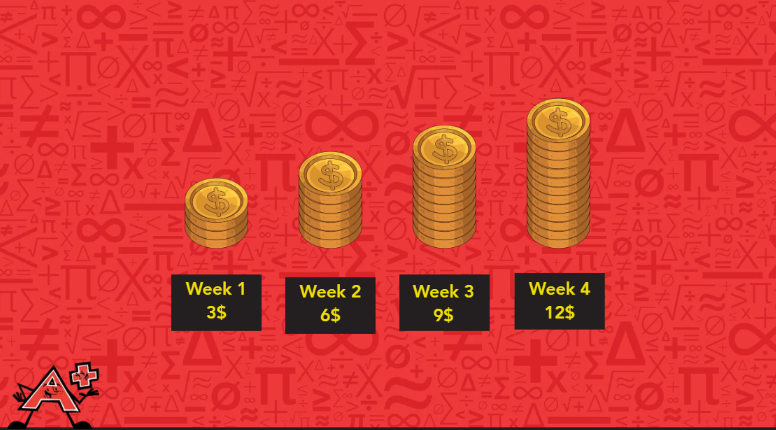
If we want to find out how much the boy will save in week 5, we can just add 3 to the week 4 sum.
12 + 3 = 15
However, if we want to calculate how much he will save in week 7, instead of adding 3 multiple times we can use a formula:
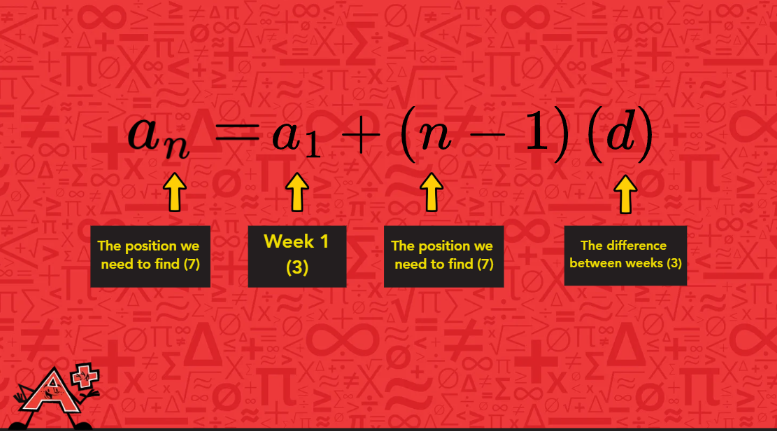
Here’s what each part of the formula means:
-
an stands for the term we want to find. Since we are looking for week 7, we write a7
-
n tells us the term’s position in the sequence. In this case, n=7.
-
a1 is the first term. Here, a1=3 because the boy saves $3 in week 1.
-
n−1 tells us how many times to add 3 after the first week.
With that in mind, let’s find the amount saved in week 7:
a7 = 3 + (7−1) (3)
The student saves $21 in week 7. The formula gives us a way to find the amount for any week without writing every number in the pattern first.
📕 You May Also Like: What Are Arithmetic Sequences in Math? A Complete Overview
What Is a Series?
A series adds the terms in a sequence. Let’s use the pattern 3, 6, 9, 12,… If we write it as a series, it becomes:
3 + 6 + 9 + 12
Do we notice any difference now? Instead of commas, plus signs are connecting the numbers because we are adding them. The pattern still increases by 3 each time, but the question we need to answer has changed. Instead of looking for the next number, we can find the total:
Because the terms increase by the same amount each time, this is an arithmetic series.
Let’s look at the weekly savings example. If someone saves $3 in the first week, $6 in the second, $9 in the third, and $12 in the fourth, the series finds the total saved after four weeks:
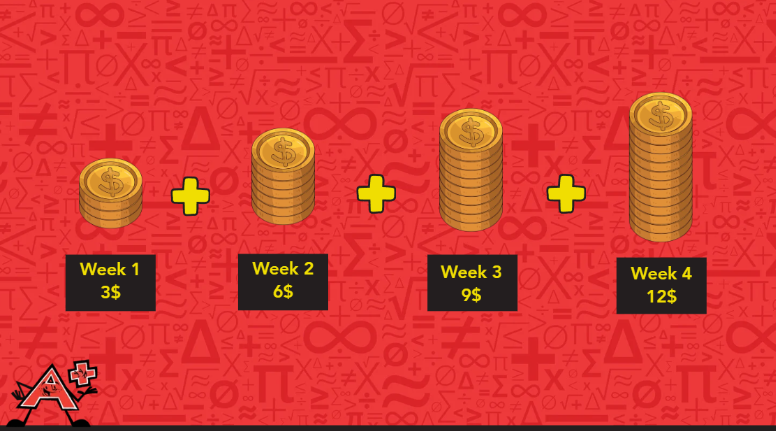
3 + 6 + 9 + 12 = 30
After four weeks, the savings total $30. The individual weekly amounts are still part of the pattern, while the series combines them into one total. We can find that sum either by simply adding the sums for weeks 1-4 or by using the formula:
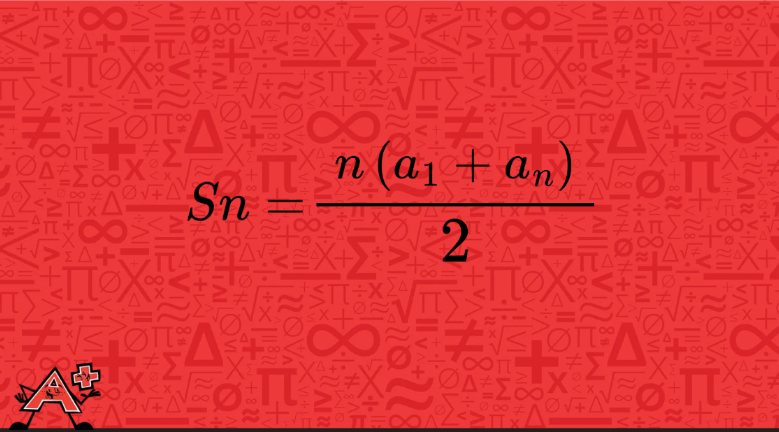
Let’s break down this formula together:
So, for the four weeks above, we calculate
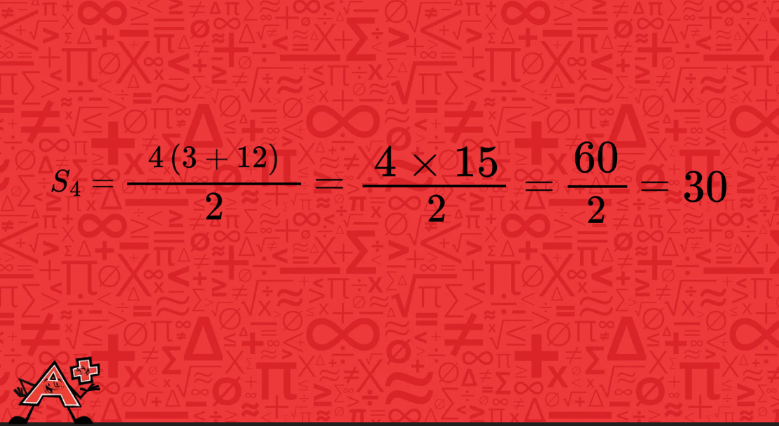
This formula gives us a faster way to find the total of a long pattern whose terms change by the same amount each time.

What’s the Difference Between a Sequence and a Series?
In math, a sequence lists numbers in a specific order, while a series adds those numbers to find a total. The numbers can follow the same rule in both cases, but the notation and the question we need to answer are different.
Let’s picture seats in a small theater. The first row has 8 seats, the second has 10, the third has 12, and the fourth has 14. Each new row has 2 more seats than the row before it. The number of seats in each row forms a sequence:

This pattern can answer a question about any row. For example, how many seats are in row 4? The answer is 14.
Now, let’s add the seats in all four rows:
8 + 10 + 12 + 14 = 44
This is a series. It answers a different question: How many seats are in the first four rows altogether? The answer is 44.
Here’s how a sequence and a series compare:
|
Sequence |
Series |
| What is it? |
An ordered list of terms |
The sum of a sequence’s terms |
| How do we write it? |
Terms separated by commas |
Terms connected with plus signs |
What question(s)
can it answer |
What is the next term in a sequence? |
What is the sum of all the terms? |
| Example notation |
a1, a2, a3,... |
a1 + a2 + a3,... |
📕 You May Also Like: Help Your Child Build Math Confidence Through Patterns
Solved Examples for a Sequence and a Series
Let’s work through a few examples to see sequences and series in action.
Example 1: Find the Next Term in a Sequence
A garden club plants 4 flowers in the first row, 7 in the second row, 10 in the third row, and 13 in the fourth row. Let’s find out how many flowers the club will plant in the next row.
Step 1: Write the Sequence
First, we need to write the sequence from the word problem.
4,7,10,13, ...
Step 2: Find the Pattern
The difference between each row is 3, so each row has 3 more flowers than the one before it.
4 + 3 = 7
7 + 3 = 10
10 + 3 = 13
Step 3: Add 3 to the Last Term.
To find the next term, or how many flowers the club will plant next, we just need to add 3 to the last term (13).
13 + 3 = 16
The next row will have 16 flowers.
Example 2: Find a Later Term
In a video game, one player gets 15 coins at level 1, 20 coins on reaching level 2, 25 coins at level 3, and 30 coins on level 4. How many coins will the player earn for reaching level 7?
Step 1: Write the Sequence
We should always write down the sequence before anything else.
15,20,25,30, ...
Step 2: Identify the First Term and the Change
The first term in the sequence is 15, and each term is +5 bigger than the previous one. So, we write:
a1 = 15
d = 5
Step 3: Use the Formula
Now, we need to find how many coins the player will get at level 7. We can find that manually by adding 5 multiple times or just use the formula to save us some time.
an = a1 + (n−1)d
Since we are looking for level 7, we write 7 for n.
a7 = 15 + (7−1)5
a7 = 15 + 65
a7 = 15 + 30
a7 = 45
The player will earn 45 coins at level 7.
Example 3: Add a Short Series
At a school fundraiser, a class collects $6 on Monday, $9 on Tuesday, $12 on Wednesday, and $15 on Thursday. How much does the class collect during the four days?
Step 1: Write the Series
We should always read the word problem and see what we have in it. So, let’s write these sums as a series.
6 + 9 + 12 + 15
Step 2: Add
With a series as short as this, we can simply add the numbers to get our result.
6 + 9 + 12 + 15 = 42
The class collects $42 during the four days.
Example 4: Add a Longer Series
Rows at a concert hall start with 18 seats in the first row. Each new row has 4 more seats than the row before it, and the hall has 20 rows. How many seats are there altogether?
Step 1: Find the Last term
To use the series formula, we need the first term and the last term. We know the first row has 18 seats (a1) and that the number of seats increases by 4 per row (d). We do not yet know how many seats are in row 20 (n).
To find that missing last term, we use the sequence formula:
an = a1 + (n−1)d
a20 = 18 + (20−1)4
a20 = 18 + 19 x 4
a20 = 18 + 76
a20 = 94
Row 20 has 94 seats, so the last term is 94.
Step 2: Find the Total Number of Seats
Now that we have the values we needed for the series formula, we write them down
n = 20
a1 = 18
a20 = 94
Then, we insert them into the formula.
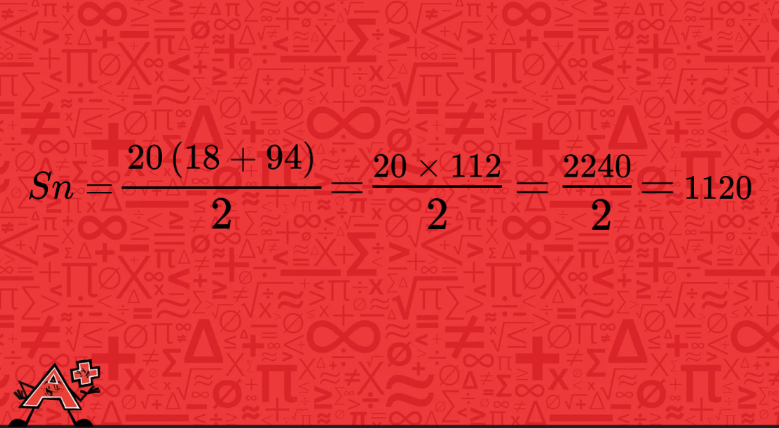
Instead of adding 4 multiple times to each new term, we used the formula to find that the concert hall has 1120 seats in total.
📕 You May Also Like: A 4-Step Method for Solving Word Problems + Examples
Quiz: Check Your Knowledge of a Sequence and a Series
Ready to practice what you've learned? Give our quiz a try and check your answers at the bottom of the guide.
Question 1: Complete the sequence 5, 9, 13, 17, ___
Question 2: A series lists numbers in order, separated by commas. True or false?
Question 3: Which expression is a series?
- 4, 8, 12, 16
- 4+8+12+16
- 4, 8+12, 16
- 4×8×12×16
Question 4: In the sequence 11, 15, 19, 23,… the common difference is ___.
Question 5: A game awards 12 points in round 1, 16 points in round 2, 20 points in round 3, and 24 points in round 4. The pattern continues. How many points will the game award in round 6?
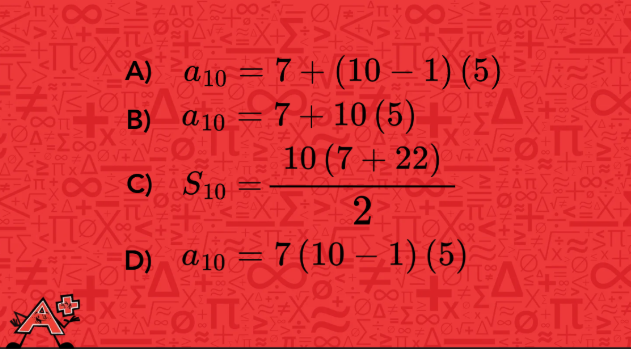
Question 6: For the arithmetic sequence 7, 12, 17, 22,…, which formula finds the 10th term?
Question 7: A reading challenge tracks 8 pages on day 1, 11 pages on day 2, 14 pages on day 3, and 17 pages on day 4. How many pages does the student read in all during the four days?
Question 8: A theater has 10 seats in row 1. Each new row has 2 more seats than the row before it. There are 15 rows. What is the total number of seats?
- 240
- 300
- 360
- 450
 At Mathnasium, our specially trained tutors guide students through concepts like sequence and series in a supportive environment one step at a time.
How Mathnasium Helps Students Master Sequence and Series (and Any Math Concept)
Mathnasium is a math-only learning center that helps K-12 students catch up, keep up, and get ahead in math.
Whether your student needs to rebuild foundational skills, master specific concepts like the difference between sequence and series, or is simply looking for additional challenges, Mathnasium provides a personalized path forward.
To provide that support, we use the Mathnasium Method™, our proprietary teaching approach, to meet students exactly where they are and guide them forward step by step.
Each student starts their Mathnasium journey with a diagnostic assessment that helps us identify their current skills, knowledge gaps, and learning goals. With those insights, we build a personalized learning plan tailored to their needs and pace.
Our specially trained tutors follow the plan closely and provide live, face-to-face instruction in a caring and fun group environment. We use mental, verbal, visual, tactile, and written techniques so any math concept can land.
For example, these techniques help them see the connection between sequence and series. So, if students get stuck on these two concepts, we break them down into manageable steps and teach both the how and the why behind them.
As time goes on, students learn to do the same independently. They walk out of our centers with the problem-solving skills and critical thinking tools they can use in the math classroom and beyond.
Fun is an important part of how we work. Sessions often include game-based and hands-on activities that keep students engaged and make learning more enjoyable. Students earn rewards along the way, and we celebrate every bit of progress, so confidence grows alongside mastery.
The results speak for themselves:
-
94% of parents report an improvement in their child's math skills and understanding
-
93% of parents report their child's improved attitude toward math after attending Mathnasium
-
90% of students saw an improvement in their school grades
With over 1,100 active learning centers, Mathnasium brings top-rated math instruction close to your community.
For families in and near Glen Cove, Mathnasium of Glen Cove is a trusted local center with years of experience helping students excel in math.
Whether your child needs to catch up, keep up, or get ahead, a free diagnostic assessment is a great place to start. From what we learn, we create a personalized learning plan to help your child master any math concept they are currently learning.
📅 Schedule a Free Assessment at Mathnasium of Glen Cove
Not near Glen Cove?
📍 Find a Mathnasium Learning Center Near You
Pssst! Check Your Answers Here
If you worked through the quiz, here are the answers:
Question 1: 21
Question 2: False
Question 3: B)
Question 4: 4
Question 5: 32 points
Question 6: A)
Question 7: 50 pages
Question 8: C) (360 seats)
How did you do?


 (516) 759-6284
 (516) 455-1665