At Mathnasium, we often hear from parents whose children feel lost when exponents first appear in math class.
A small raised number can turn an otherwise familiar problem into something that feels abstract and confusing. Even students who are confident with multiplication may stumble when trying to make sense of what an exponent really means.
When this happens, we draw on different approaches, including visual models, to help them see the math behind the concept.
To give parents a head start, our tutors have put together this guide with three visual, beginner-friendly strategies that make exponents easier to grasp at home.

What Are Exponents and Why Students Often Struggle with Them
An exponent is a simple way of showing repeated multiplication. When we write 3², we mean “three multiplied by itself once more,” or 3 × 3 = 9.
In other words, the small raised number (the exponent) tells us how many times the big number (the base) is used as a factor.
When students first encounter this concept, we often see the same stumbling blocks at our centers:
-
Mixing up symbols: It’s common for students to assume 3² means 3 × 2 rather than 3 × 3.
-
Jumping to shortcuts too quickly: Students may say “just add a zero” when working with 10², or “double it” when moving from 2² to 2³, without seeing the actual multiplication behind it.
-
Relying on memorization: Some can recite answers but can’t explain why, which leaves them vulnerable when problems look different from the ones they practiced.
Beyond these mistakes, exponents often feel abstract to students. They can picture three apples or even three rows of apples, but “three to the fourth power” doesn’t come with a natural image.
Unlike addition or multiplication, exponents don’t connect to everyday experiences, so students often feel like they’re working with a rule that has no anchor.
Because they can’t “see” what the math represents, even small changes in a problem can cause hesitation, and their confidence quickly erodes.
When we notice a student facing this kind of challenge, we pause and bring the idea back to something concrete they can visualize, whether that’s arranging objects in an array, sketching a square or cube, or building a simple table of patterns.

Exponents feel hard when kids memorize rules without really seeing the math behind them.
Strategy 1: Repeated Multiplication with Arrays
To begin, let’s take the most straightforward way to picture an exponent.
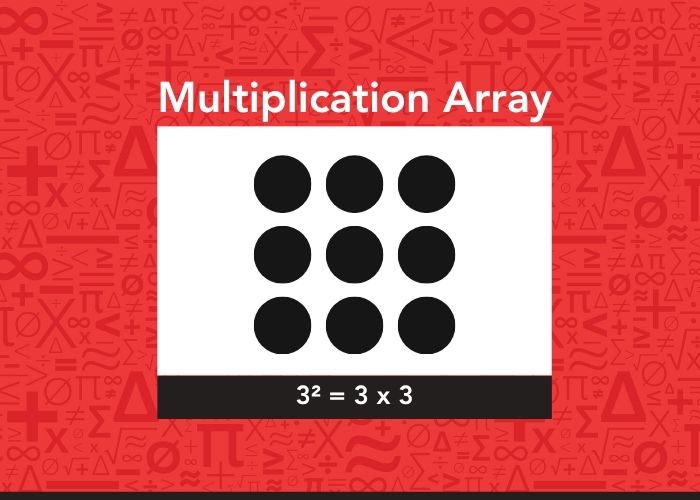
Write 3² on a sheet of paper and tell your child it means “three times itself.” Then ask them to draw three rows of three dots. Right away, they’ll see 3 × 3 take shape in front of them.
Each row is one copy of three, and together the rows form a square of nine dots. Instead of being an abstract symbol, 3² becomes something your child can count and explain.
How does that help, you may wonder?
It clears up one of the most common confusions. Students often see 3² and think it means 3 + 3. By looking at the array, the difference becomes obvious. Exponents multiply, not add.
To go a step further, show your child how to write 3³ and explain it means “three multiplied by itself three times.”
Have them draw the same 3 × 3 square of dots from 3², then add two more underneath. Together, the three layers represent 3 × 3 × 3. Each square has nine dots, and stacking three gives 27.
This helps your child see that the base stays the same, while the exponent tells how many times the base is used in multiplication.

As an alternative, you can swap the dots for household items like coins, beans, or cereal pieces. Line up three rows of three to show 3², then build three of those squares to show 3³.
We’ve found that students often enjoy this hands-on version because they can move the objects, count them directly, and connect the symbol to something concrete.
📕 You May Also Like: How to Use Math Manipulatives Effectively at Home
Strategy 2: Area Models and Cubes
Our tutors often turn to geometry to help students make sense of exponents.
The words squared and cubed come directly from shapes they already know.
A square has equal sides, and its area is found by multiplying one side by itself. A cube has equal edges, and its volume is found by multiplying the edge three times.
By tying exponents to geometry, students notice the patterns that connect different areas of math.
You can try this at home by starting with something simple like 2². Write it down, then draw a square with side length 2 units. Because the side is 2, the area is 2 × 2. Divide the inside into 1 × 1 unit boxes so your child can count them.
They’ll find two rows and two columns, giving four small squares in total. Count them together and point back to the notation: 2² = 4 because the area of a 2-by-2 square is 4 units.

Once that makes sense, try 3². Draw a square with side length 3 and mark off the space inside. Your child will find nine unit squares altogether.
This quick follow-up shows them that “squared” always connects to the area of a square, no matter its size, and reinforces the idea that exponents have a geometric meaning.

Now extend the idea to cubes.
Write 3³ and explain that this time the exponent connects to a cube, which has three equal dimensions: length, width, and height.
Show your child the cube model divided into smaller cubes. There are 3 cubes across, 3 cubes back, and 3 cubes high.
Counting them gives 27 little cubes in total. Point back to the notation: 3³ = 27. The exponent “3” links directly to the three dimensions of a cube, which is why we call it “cubed.”

Strategy 3: Exponent Tables and Doubling Patterns
Another clear way to work with exponents is by laying them out in a table. This makes the pattern visible: each new row multiplies the previous value by the base number. With base 2, that means every result doubles as you go down the table.
Here’s what it looks like when you write it out together:
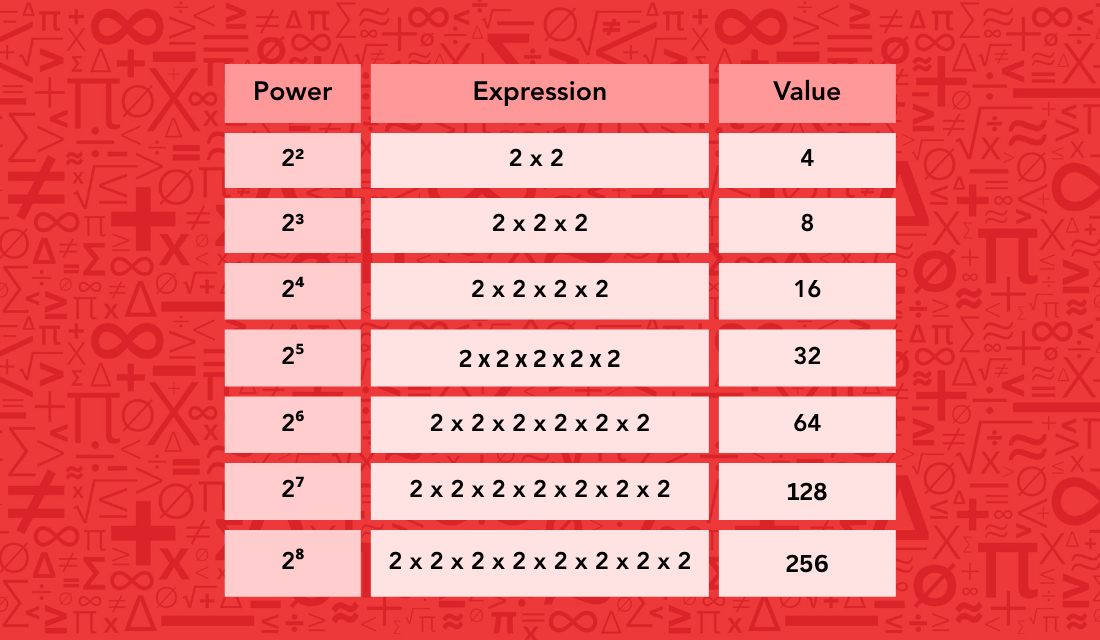
Ask your child what they notice. The key pattern is that each value is twice the one above it. Once they see this, ask them to predict the next number before calculating.
This step helps them connect exponents with a growing sequence rather than treating each problem as separate.
You can make the table more visual by drawing arrows from one row to the next and labeling them “×2.” Another option is to put each step on a flash card so your child flips through and sees the doubling happen.
This method works well because it encourages noticing. Students begin to recognize that exponents generate predictable growth: 2, 4, 8, 16, and so on. Later, this awareness makes it easier to understand why exponent rules behave the way they do.
📕 You May Also Like: What Does “Squared” Mean in Math? Explain It to a 10-Year-Old
Mastering Exponents (and Beyond) with the Mathnasium Method™
At Mathnasium, we often meet students who need to rebuild key foundations, whether it’s fractions, multiplication, or exponents. To support them, we use a proprietary teaching approach called the Mathnasium Method™.
How does this work?
It begins with a diagnostic assessment that pinpoints each child’s strengths and areas for growth. For some, that means solidifying exponents; for others, it may be mastering geometry or filling earlier gaps. The assessment also gives us insight into how a student learns best, whether they respond more strongly to visual, kinesthetic, or other styles of learning.
With this information, we design a learning plan tailored to the student’s needs. Our specially trained tutors then follow that plan in a face-to-face, small-group environment that is structured, supportive, and designed to build confidence.
Tutors explain concepts in clear, natural language instead of overly technical terms. We also use a blend of mental, verbal, visual, tactile, and written techniques to adapt to various styles of learning.
Most importantly, we don’t stop at getting the right answer. We guide students to understand the “why” and the “how” behind every concept. This builds true comprehension, fosters problem-solving skills, and encourages the kind of critical thinking that benefits students both inside and outside the classroom.
After enrolling at Mathnasium, students see measurable results:
-
94% of parents report an improvement in their child’s math skills and understanding
-
93% of parents report a more positive attitude toward math
-
90% of students show better grades in school
With more than 1,100 learning centers nationwide, Mathnasium brings top-rated tutors and a proven approach to local communities.
For families based in Denver, Mathnasium of Highlands is a local center with years of experience helping students strengthen skills, fill gaps, and build a genuine love for math.
If your child needs support with exponents or any other math concept, Mathnasium of Highlands is ready to help. Schedule a free diagnostic assessment to get started, and watch as their skills and confidence grow session by session.
📅 Schedule a Free Diagnostic Assessment at Mathnasium of Highlands
Not near Denver?
📍 Find Mathnasium Learning Centers Near You


 (720) 524-4763
 (720) 524-4763