What Is an Expression in Math? A Beginner-Friendly Guide
May 23, 2025
| Littleton
You’ve probably heard the word expression in your math class more times than you can count.
Maybe your teacher said, “Let’s look at this expression,” or your workbook asked you to “solve the expression.”
But… do we actually know what an expression is?
This guide is here to help you find out.
Read on to explore simple definitions, practical examples, practice exercises, and answers to frequently asked questions, all designed to help you understand and work with expressions in math.
At Mathnasium, we like to say an expression is a mathematical phrase with no equality or inequality sign.
If there’s no equals sign, then what is in an expression?
Well, an expression has a minimum of two terms, which can be numbers or variables. And those terms have to be connected with one operation, such as addition, subtraction, multiplication, or division.
It’s a bit like putting together ingredients in a recipe. You haven’t baked the cake yet, but you’ve got everything mixed and ready to go.
So, what would be an example of an expression?
Well, if we know an expression has no equality or inequality sign and at least two terms, it could look like this:
6 + 2 — two numbers connected by addition
x + 7 — a variable and a number connected by addition
4 × y – 3 — three terms connected by multiplication and subtraction
a + b + c — three variables, all added together
And what wouldn’t be an expression?
We just flip the rules:
12 — just one number
2y — a variable and a number, but only one term
14 – x = 5 — this one includes an equals sign, so it’s not an expression
See how Mathnasium’s proprietary teaching approach, the Mathnasium Method™, helps students learn and master any math topic, including expressions.
Components of an Expression in Math
An expression in math can consist of:
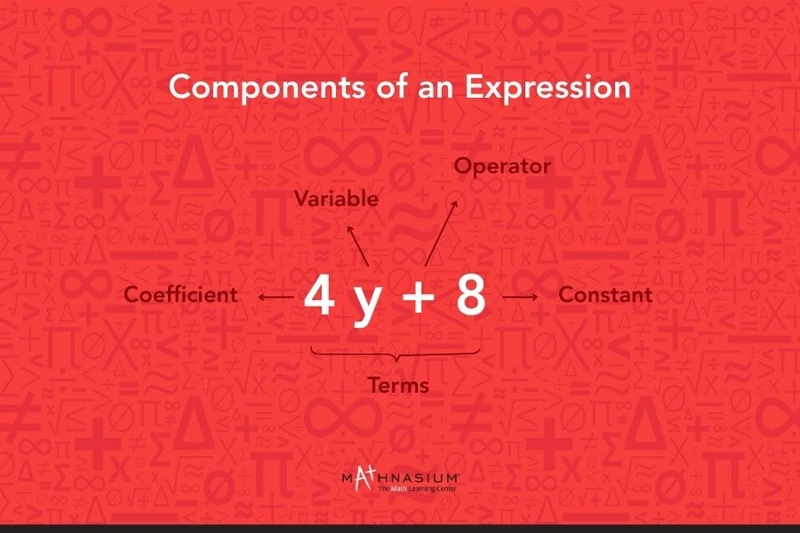
Constant: a quantity that does not change in value (such as 5, \(\Large\frac{1}{2}\), –2, \(\sqrt{9}\))
Variable: something that changes or has no fixed value (such as a, x, y, z)
Coefficient: A number or symbol multiplying another number or symbol (like 3 in 3x or –2 in –2y)
These terms are connected by an operator, which is a symbol that shows which operation to perform (+, –, ×, ÷)
There are no rules for how many constants, variables, or coefficients an expression must have. As long as there are at least two terms and one operator connecting them, you've got an expression.
Types of Math Expressions
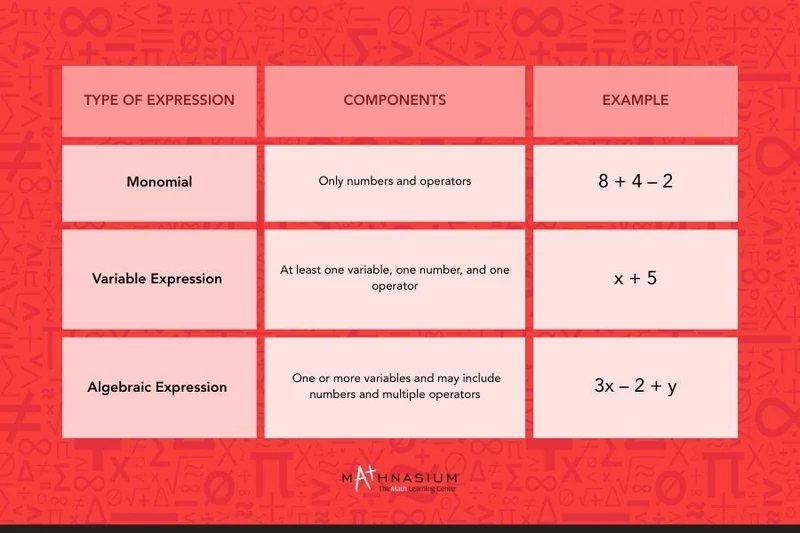
There are three basic types of math expressions. The difference between them depends on the kinds of terms they include.
To make things easier to see and compare, let’s organize them side by side:
Algebraic Expressions
Algebraic expressions are one of the most important types you'll see, especially in middle school and beyond. They include variables, numbers, and operators, and can look simple or more complex depending on how the parts are arranged.
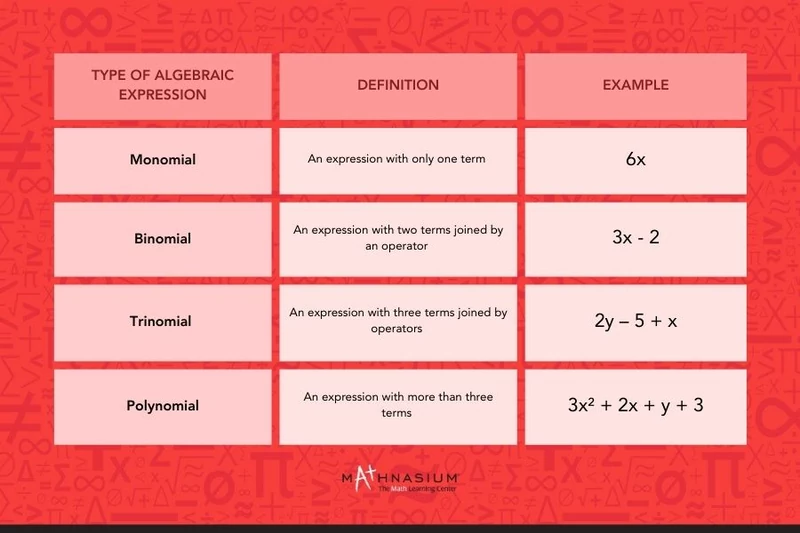
We can go a step further and divide algebraic expressions into smaller categories based on how many terms they have.
We can organize algebraic expressions like so:
Expression vs. Equation: What’s the Difference?
Many students, and even adults, can’t really tell the difference between expressions and equations in math. In fact, you’ll often hear these terms used interchangeably, even though they are not the same.
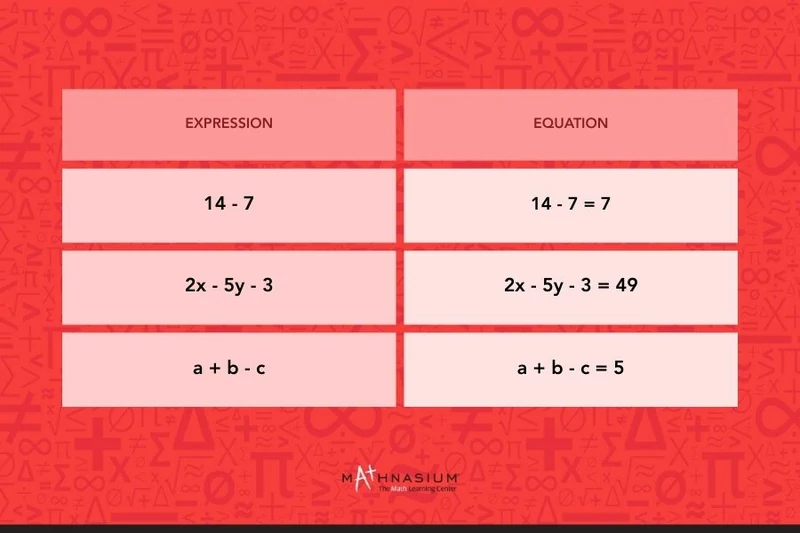
In the simplest terms, the difference comes down to the equal sign.
An expression, as we discussed earlier, does not have an equal sign or an inequality sign.
An equation has an equal sign placed between two math expressions.
And that’s it.
Flash Quiz: Test Your Knowledge of Expressions
Think you’ve got the basics down? Try these quick questions to check your understanding.
When you're finished, check your answers at the bottom of the guide.
1. Which of the following is not a math expression?
a) 4x + 7
b) y – 3
c) 8 + 5 = 13
d) 2a – 6
2. The value of this term in the expression always remains fixed. What is it called?
a) Variable
b) Operator
c) Constant
d) Coefficient
3. What type of expression is this: 2a + 3b – 4?
a) Numerical expression
b) Variable expression
c) Algebraic expression
d) Equation
4. If an algebraic expression has three terms, what is it called?
a) Trinomial
b) Triple variable
c) Equation
d) Expression line
5. What is the main difference between an expression and an equation?
a) An expression includes a variable, and an equation does not
b) An equation includes an equal sign, and an expression does not
c) An expression always has three terms
d) Equations are always longer than expressions
6. Which of the following is a variable expression?
a) 8 + 4
b) x + 3
c) 12 = 4
d) 3 × 5
FAQs About Expressions in Math
As students explore math, especially around 5th and 6th grade, expressions can lead to a few common questions. We’ve gathered a list of the ones we often hear at Mathnasium of Littleton, along with answers to help you feel more confident as you learn.
1. When do students start learning about expressions in math?
Students are introduced to the idea of expressions as early as 4th or 5th grade, often starting with simple numerical expressions like 4 + 6.
As they move into middle school, they begin to work with variables, learning to recognize and build algebraic expressions. From there, expressions show up throughout the rest of a student’s math journey: in algebra, geometry, and beyond.
2. Can an expression include only variables and no numbers?
Yes, it can. An expression like x + y or a – b includes only variables and operations, and that still counts as a valid expression.
As long as there are at least two terms and one operation, it’s an expression, even if no numbers appear.
3. Can you have parentheses in an expression?
Yes! Parentheses are often used in expressions to group terms or show the order in which to perform operations. For example, in the expression 2 × (x + 3), the parentheses tell you to add x + 3 first before multiplying by 2.
4. Can an expression be negative?
Yes. An expression can include negative numbers, and the result of simplifying an expression might also be a negative value. For example, 5 – 12 is a valid expression, and its value is negative.
Master Expressions with Top-Rated Math Tutors in Littleton
Mathnasium of Littleton is a math-only learning center for K–12 students of all skill levels in Littleton, CO.
Using our proprietary teaching approach, the Mathnasium Method™, our specially trained math tutors provide face-to-face instruction in a caring and engaging environment to help students truly understand and master math topics, including expressions, which are introduced in upper elementary and developed throughout middle and high school.
Students begin their Mathnasium journey with a diagnostic assessment that helps us identify their specific strengths and knowledge gaps. Using these insights, we create a personalized learning plan that puts each student on the best path toward math mastery.
Whether your student is looking to catch up, keep up, or get ahead in math, schedule an assessment and enroll at Mathnasium of Littleton today!
If you’ve given our quiz a try, check your answers here to see how well you understand expressions in math!
1. Which of the following is not a math expression?
Answer: c) 8 + 5 = 13
(This is an equation because it has an equal sign.)
2. The value of this term in the expression always remains fixed. What is it called?
Answer: c) Constant
(A constant is a number that does not change.)
3. What type of expression is this: 2a + 3b – 4?
Answer: c) Algebraic expression
(It includes variables, numbers, and operations.)
4. If an algebraic expression has three terms, what is it called?
Answer: a) Trinomial
(“Tri” means three, so a trinomial has three terms.)
5. What is the main difference between an expression and an equation?
Answer: b) An equation includes an equal sign, and an expression does not
(The equal sign is what separates equations from expressions.)
6. Which of the following is a variable expression?
Answer: b) x + 3
(This expression has a variable and no equal sign, which makes it a variable expression.)
Visit Us at Mathnasium of Littleton
Mathnasium of Littleton is a math-only learning center for K-12 students in Littleton,
CO. Trusted by over a million parents, Mathnasium uses personalized learning plans
and the proprietary Mathnasium Method™ to help students catch up, keep up, and get ahead on their math journey.
Our specially trained tutors deliver face-to-face instruction in a supportive and fun small-group environment,
working with students both in center and online to develop a deep understanding of math, build confidence,
and improve academic performance.
A University of Salford study found that the physical learning environment can account for up to 25% of the difference in children s academic progress over a school year. That number may sound surprising, but if you ve ever watched your child struggle thr..
One of the biggest concerns parents of middle schoolers we teach come to us with is algebra, or specifically, algebra readiness. ” Other kids seem to be taking it in 7th grade. The school is suggesting 8th. What do we do?” The concern here is whether gett..


 (303) 979-9077
 (303) 979-9077