Long division is a topic that often trips students up, and one we work on frequently at Mathnasium. Even students who feel confident with basic division can get stuck when the steps begin to stack up.
When that happens, we slow things down.
Long division isn’t a trick question. It’s a process, and like any process, it becomes easier with practice and the right kind of support.
At our centers, worksheets absolutely play a role in that practice. But we also like to mix things up with creative, hands-on activities that reinforce the concept in a fresh way. With that in mind, our tutors are sharing X fun ways to make long division practice more engaging at home—no worksheet required.

A Quick Reminder: What Is Long Division?
Before we jump into the activities, let’s take a moment to revisit what long division is all about.
Long division is a step-by-step method we use when dividing larger numbers, especially when the answer isn’t obvious at a glance. It helps us break the problem into smaller, manageable parts.
Here’s how it goes:
-
Divide: Look at the first digit (or group of digits) of the number you're dividing. Ask: how many times does the divisor fit into it?
-
Multiply: Multiply that answer by the divisor.
-
Subtract: Subtract to find what’s left.
-
Bring down: Drop down the next digit and repeat the process.
If there are still digits left, we go through the steps again. If not, the problem is complete.
To help students remember the steps, we often use a quick mnemonic like:
“Does McDonald’s Sell Burgers?”
or a simpler one:
“Dad, Mom, Sister, Brother”
Still need a refresher? We’ve got a full breakdown of the steps in our comprehensive long division guide.
And yes, we know—keeping track of all these steps can get messy. But like anything in math, the more we practice, the better we get. Simple as that.
Now, for a more inventive take, here are a few activities to make that practice feel a little more enjoyable.
📕 You May Also Like: What Is Division in Math? A Simple & Complete Overview
1. Break It Down: Long Division with Base-Ten Blocks
We’re kicking things off with a classic. This isn’t about running through the steps of long division just yet. Think of it as a warm-up to help your child build the conceptual understanding that division is really about creating equal groups.
To do this activity, you’ll need:
-
A set of base-ten blocks (or any manipulatives that can represent hundreds, tens, and ones)
-
A few pieces of paper or index cards to represent each group based on your divisor
Let’s say we have 445 ÷ 4.
Grab your base-ten blocks and build the number 145 using:
-
4 hundred block
-
4 ten rods
-
5 ones
We’ll go step by step:
-
Start by creating a space for each group. If you’re dividing by 4, you’ll need four spaces. Use paper squares or index cards to lay out the groups on your table.
-
Now, look at the hundreds. Since you have 4 hundred blocks and you’re dividing by 4, it’s a perfect fit; place one hundred block into each group.
-
Next, move to the tens. You have 4 ten-rods. Divide them the same way, one into each group.
-
Then look at the ones. You have 5 ones, but only 4 groups. Each group gets 1 one block, and there’s 1 leftover. That’s your remainder.
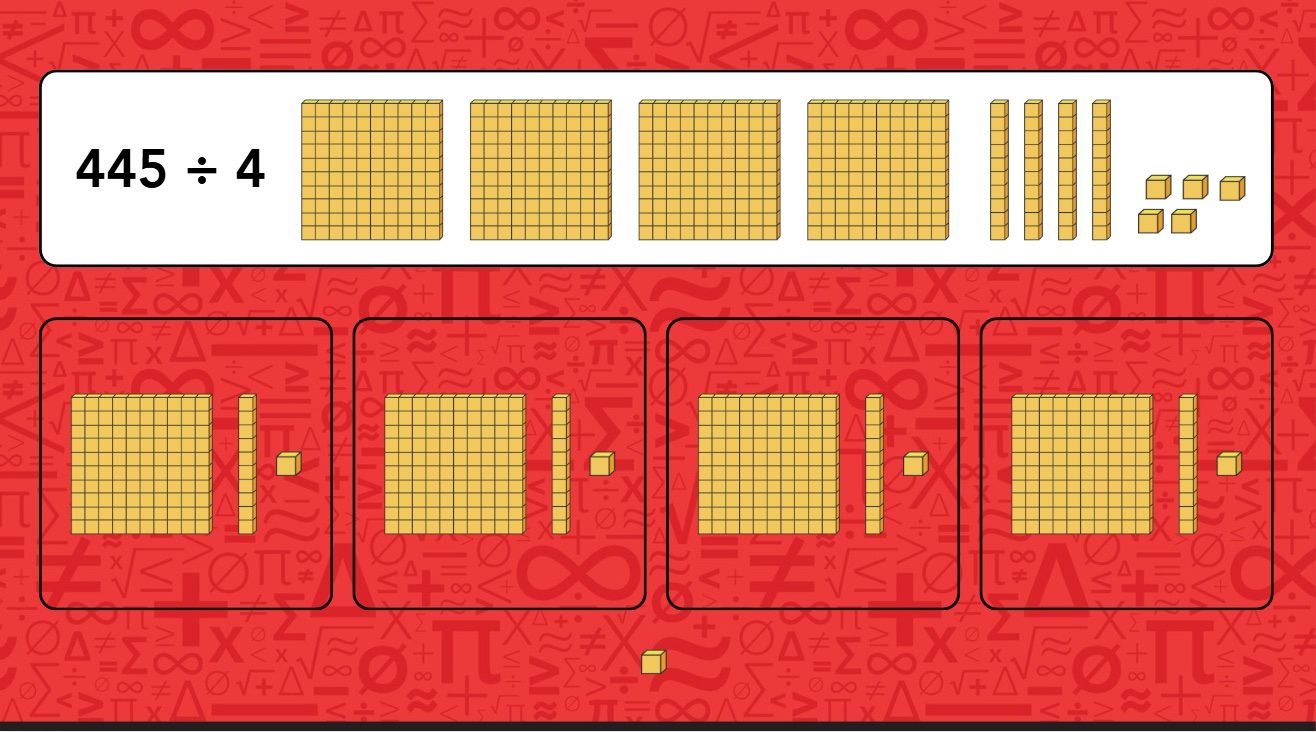
And for cases when you can’t divide a place value evenly, just regroup it. Trade 1 hundred block for 10 tens, or 1 ten for 10 ones, so you can keep dividing without leaving anyone out.
📕 You May Also Like: How to Use Math Manipulatives Effectively at Home
2. Flip & Solve: Long Division with Playing Cards
If your student tends to lose focus halfway through long division or just feels burned out from worksheets, this activity can flip the script.
With a standard deck of playing cards and a few paper strips, you can turn long division into something hands-on, visual, and even a little fun.
Here’s what you’ll need:
-
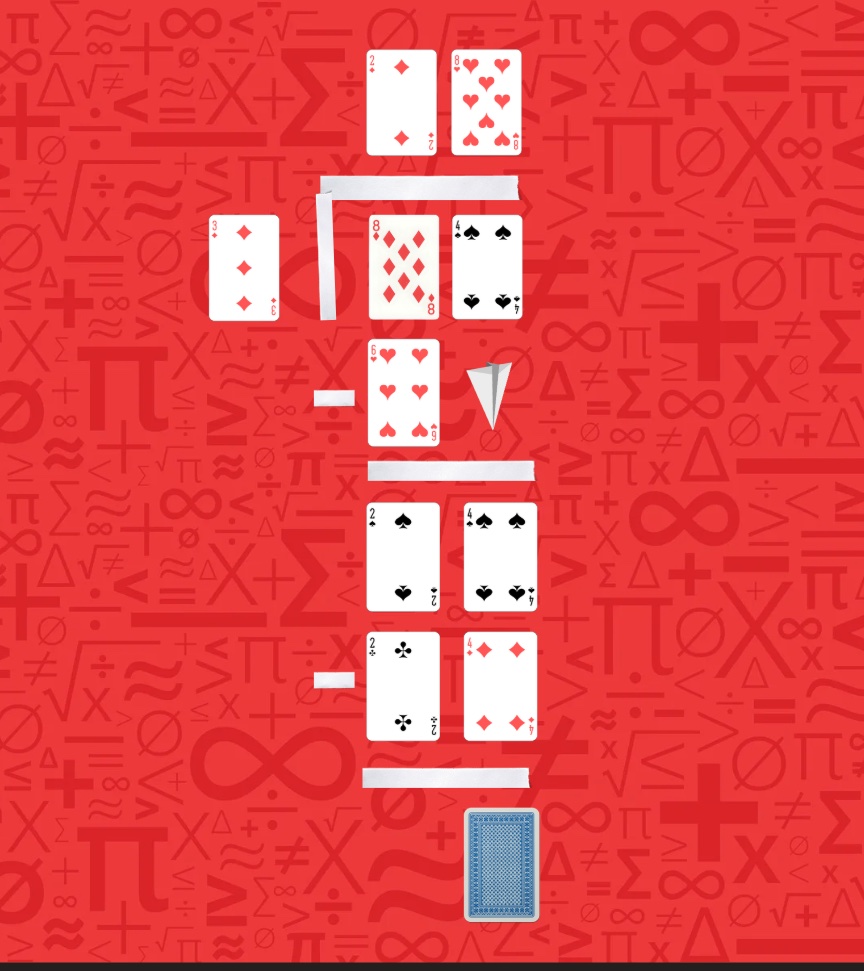
A deck (or a few) of playing cards: Use number cards only (Ace = 1, face cards removed or used as zeroes). These will stand in for the digits in your long division problem.
-
Strips of paper or cardstock: Use these to build the long division bracket, horizontal lines, minus signs, and placeholders for each step. Cut out a letter “R” to mark the remainder (when needed). Think of it like a physical version of the long division format on paper. Some families even laminate the strips for reuse.
-
A flat surface: A table or desk gives you the space to lay everything out clearly. You'll be building the full problem in front of you, digit by digit.
And the rules? As simple as this:
-
Start by setting up the division bracket using your paper strips.
-
Pick random cards from the deck to create the dividend and divisor, and keep them face down. If you’re just getting started, begin with a 2-digit dividend and a 1-digit divisor, then build up from there.
-
Walk through the long division steps: divide, multiply, subtract, bring down. Say each step out loud as you solve. This helps with focus, reinforces the correct order, and makes it easier to catch mistakes as you go.
-
Check your answer. Multiply the quotient by the divisor, then add the remainder (if there is one). You should land right back at your original dividend.
-
Switch roles and go again until your child feels comfortable with both the game and the math behind it.
📕 You May Also Like: 5 Fun Math Card Games You Can Play with a Standard Deck
3. Pass the Problem: Long Division Relay
You know how much fun a relay race can be: each person runs their stretch, then hands it off? The same idea works for long division. Instead of doing the whole process solo, this activity lets kids share the steps with a partner or group.
It’s a team effort that works best if your child has a sibling to practice with or friends over after school. And yes, you can absolutely join in as the grown-up "math coach"—just be ready to get competitive!
This one’s light on materials and quick to launch. You’ll need:
So, how does that relay work? The rules are:
-
Roll the dice to create your long division problem. Since this is a team effort that needs a bit of a challenge, we recommend rolling the dice three or four times in a row to create a 3- or 4-digit dividend, and rolling once more to get your divisor. You can adjust the size of the numbers depending on your child’s comfort level.
-
The first player solves the first step: divide. They write their step on the paper, and they’re welcome to talk it out as they go.
-
The next player takes over for the next step: multiply. Just like in a real relay, each person handles one part before handing it off again.
-
Keep passing after each step—subtract, bring down, then divide again. Repeat the full cycle of steps until the entire problem is solved.
-
At the end, check the answer together.
Want to make it more fun?
-
Try a silent round. No talking allowed. just passing the problem and thinking through your own step.
-
Add a timer. Give each player 30 seconds or less per step to keep the energy up.
-
Trade off roles. After every round, switch who goes first, so everyone gets practice with different steps.
📕 You May Also Like: 10 Fun Math Games to Play at Home with Your Child

Long division relay works great with siblings or classmates, just grab a pencil and pass the problem.
How Mathnasium Makes Math Learning Engaging and Fun
Students come to Mathnasium with specific goals, whether it’s mastering a skill like long division, rebuilding foundations, or seeking a new challenge in math. To help them succeed, we personalize every student’s learning experience because we know no two learners are alike.
At the core of this personalization is our proprietary teaching approach, the Mathnasium Method™—a way of teaching math that’s both fun and meaningful.
It all starts with a diagnostic assessment, which gives us insight into what your child already understands, where they may need support, and how they learn best. From there, we create a customized learning plan tailored to their unique strengths and needs. No two plans are alike.
Once the plan is in place, our specially trained instructors guide students through it with face-to-face instruction in a supportive, confidence-building environment.
During each session, we combine Socratic questioning, direct teaching, and multi-sensory techniques, including verbal, visual, mental, tactile, and written methods, to help students deeply understand every concept, including long division.
We don’t just focus on getting the right answer. We teach the how and the why behind the math, so students grow into critical thinkers and independent problem-solvers.
When working on more complex topics like long division, we often incorporate games, hands-on activities, and meaningful rewards to keep students motivated and engaged. That’s why many students say our sessions don’t feel like traditional lessons at all.
And the results speak for themselves:
-
94% of parents report an improvement in their child’s math skills and understanding
-
93% of parents report a better attitude toward math after attending Mathnasium
-
90% of students saw an improvement in their school grades
With over 1,100 locations nationwide, Mathnasium is the trusted math learning center for families across the country. For those in and around Irvine, CA, Mathnasium of Northwood brings years of experience helping K–12 students build a deep, lasting understanding of math.
Whether your child needs to catch up, keep up, or get ahead, we are happy to help!
📅 Schedule a Free Diagnostic Assessment at Mathnasium of Northwood to get started!
Not near Irvine?
📍Find Mathnasium Learning Centers Near You


 (949) 688-6284