If you are sharing a box of cookies with friends, you probably want to make sure that everyone gets their fair share – the same number – of cookies, right? To do so, you will simply divide the total number of cookies by the number of people you are sharing them with (plus you, of course).
The number of cookies you calculate per person is the quotient – the star of today’s guide!
The quotient is the answer to every division problem. It tells us how much each person or group gets when we divide something.
In this guide, we’ll explore what a quotient is, how it works in division, and why it’s an important part of math.
Meet the Top-Rated K-12 Math Tutors in Parker
What Is a Quotient?
A quotient is the result we get when we divide one number by another.
Let's look at an example:
We have 12 apples and we want to share them equally with 3 friends. We divide the apples into 3 equal groups. After a simple division 12 ÷ 3 = 4, we can determine that each person should get 4 apples.
The number 4 is the quotient because it tells us how many apples each person gets.
Quotients are everywhere in our daily lives, even when we’re not thinking about math.
Any time we share something equally—like splitting a pizza with friends, dividing up chores at home, or figuring out how much time to spend on different activities—we're using quotients.
They help us divide things fairly and make sure everyone gets their equal share.
Terms Related to Quotient
Now that we know the quotient is the answer to a division problem, let’s take a moment to refresh our memory on how division works—because understanding its parts helps us solve problems faster and with more confidence.
We use division when we need to split something into equal parts or group items fairly. Whether we're sharing snacks, organizing teams, or dividing up time, knowing how division works allows us to apply it correctly in everyday situations.
Every division problem includes three key parts:
- Dividend – the total amount being divided
- Divisor – the number of groups or how many items go in each group
- Quotient – the result of the division
Let’s take the example 15 ÷ 3 = 5
- 15 is the dividend (the total number).
- 3 is the divisor (how many groups we divide into).
- 5 is the quotient (how many in each group).
Types of Quotient
In most cases, when we divide two numbers, division works out perfectly, and the quotient is a whole number.
In some other cases, we’re left with extra pieces or we need a more precise result. That’s why we have different types of quotients—whole numbers, quotients with remainders, and decimal quotients.
1. Whole Number Quotients
Whole number quotients are the simplest type of division result. They show up all the time in real life, like when we fill egg cartons, count chairs in rows, or group pencils into equal sets.
A whole number quotient happens when we divide a number, and everything splits perfectly into equal groups—without anything left over. This means that the divisor (the number we're dividing by) fits exactly into the dividend (the total number being divided), and there aren’t any extra steps like dealing with remainders or decimals
Think of it like dividing a bag of marbles among friends.
If we have 20 marbles and we want to split them equally into groups of 4, we can do so without any marbles left over. Each group will have exactly 5 marbles, and nothing is left behind.
An example of a whole number quotient would, therefore, be 20 ÷ 4 = 5
- 4 fits into 20 exactly 5 times (because 4 × 5 = 20).
- The quotient is 5—a whole number.
- There is no remainder, so the division is perfectly even.
2. Quotients with Remainders
Sometimes when we divide two numbers, the number doesn’t split evenly into equal groups, leaving us with extra pieces.
These leftover pieces are called a remainder, and we write them as R followed by the remaining amount.
Let’s try to solve 13 ÷ 5 =?
- 5 goes into 13 exactly 2 times (5 × 2 = 10).
- But wait, we still have 3 left over because 10 is not quite 13.
- Since 5 cannot fit into 3, we can’t divide any further using whole numbers.
- We write the answer as: 2 R3 (which means 2 full groups with a remainder of 3).
Imagine we have 13 chocolates and want to share them equally among 5 friends. Each friend gets 2 chocolates, but there are 3 chocolates left over that can’t be evenly divided.
This remainder tells us that we need another way to fairly share what’s left—maybe by breaking them into smaller pieces or saving them for later.
Remainders are important because they show us when division isn’t perfect.
But sometimes, we don’t want to leave a remainder—especially when working with money or measurements. That’s when we use decimals instead. So, let’s explore decimal quotients!
3. Decimal Quotients
Instead of stopping our calculations when we get a remainder after division, we can write the quotient as a decimal. This allows us to get an exact answer instead of a remainder.
Decimals help us get a more precise answer, especially when dealing with money, measurements, or things that need to be divided evenly. In these cases, we don’t want leftovers—we want an exact answer.
When dividing money, decimals help us split the total fairly—for example, if a $10 bill needs to be shared among four people, each person should get $2.50, not "$2 with $2 left over".
Decimals also help us when working with distances—if a 10-mile trip is split into four equal parts, each section would be 2.5 miles long, not "2 miles with 2 miles left over."
The best part about decimal quotients is that they let us keep dividing until we reach an exact answer—no leftovers, no confusion, just the perfect amount for everyone.
Let’s look at an example: 10 ÷ 4 =?
- First, we divide: 4 fits into 10 exactly 2 times (because 4 × 2 = 8).
- But wait: 10 isn’t a perfect multiple of 4. We still have 2 left over.
- Instead of writing R2, we place a decimal point and add a zero next to the remainder. Now we have 20 tenths instead of just 2.
- Now, we divide again: 4 fits into 20 exactly 5 times (4 × 5 = 20).
- The final quotient is 2.5 instead of 2 R2!
This means that instead of saying “The answer is 2, with 2 left over,” we can say, “The answer is exactly 2.5.”
How to Find the Quotient: Step-by-Step Guide
Now that we know a quotient is the answer to a division problem, let’s learn how to find it.
Sometimes division is quick and easy, (such as 18 ÷ 6), while other times, we need to use long division to solve bigger problems (such as 84 ÷ 4). Don’t worry—we’ll go step by step so that division, whether short or long, becomes simple and fun.
1. Simple Division (Single-Digit Numbers)
When dividing smaller numbers, we can often find the quotient just by knowing our multiplication facts.
Let’s look at this problem:
18 ÷ 6=?
- First, ask: How many times does 6 fit into 18?
- We can think of multiplication: 6 × ? = 18.
- Since 6 × 3 = 18, we know that 18 ÷ 6 = 3.
Imagine we have 18 crayons and want to put them into boxes that each hold 6 crayons. Since 6 fits into 18 exactly 3 times, we will need 3 boxes.
Let’s try another one:
35 ÷ 7=?
- We think: 7 × ? = 35
- Since 7 × 5 = 35, we know that 35 ÷ 7 = 5.
The trick to solving single-digit division is knowing our multiplication tables. If we can multiply quickly, then we can divide quickly too.
Long Division (Multi-Digit Numbers)
When we divide larger numbers, we use long division to help us break the problem into smaller steps.
Let’s go through it together.
Example: 84 ÷ 4=?
Step 1: Set up the problem
- Write 84 inside the division bracket (the "house").
- Write 4 outside as the divisor.

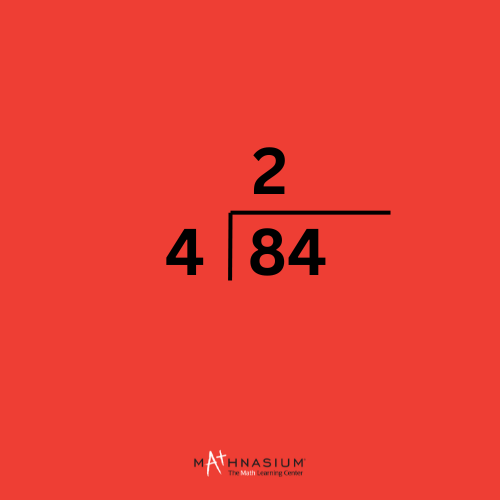
Step 2: Divide
- Look at the first digit (8).
- Ask: How many times does 4 go into 8?
- 4 goes into 8 exactly 2 times, so the first digit of the quotient is 2.
- Write 2 in the quotient above the 8.
Step 3: Multiply
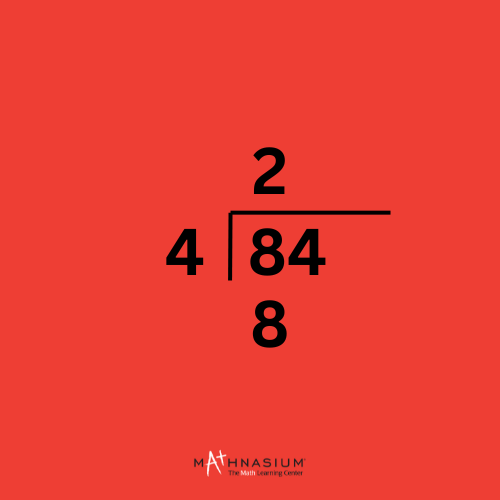
- Multiply 2 by 4 and we get 8
- Write 8 below the 8 in 84.
Step 4: Subtract
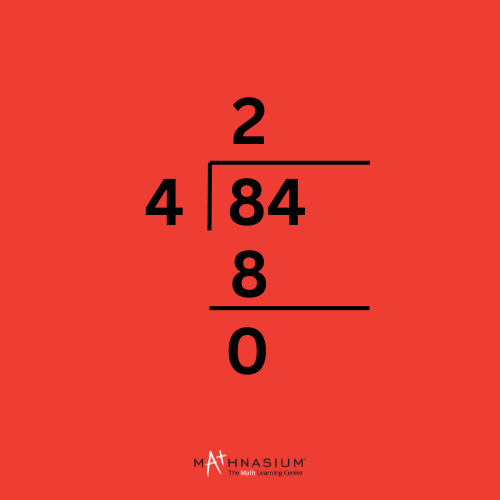
Now subtract 8 - 8 = 0.
Step 5: Bring Down
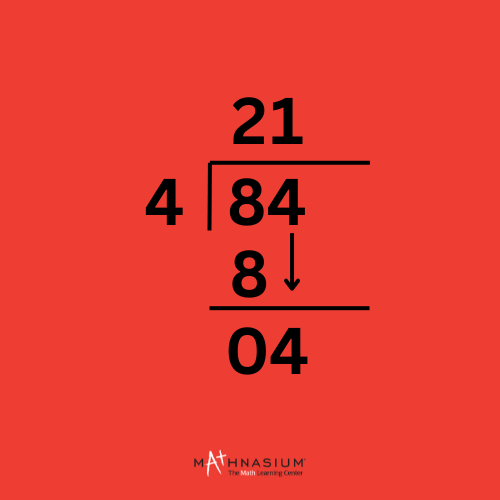
Bring down the next digit (4) from the dividend.
Step 6: Divide Again
- How many times does 4 go into 4?
- The answer is 1 (because 4 × 1 = 4).
- Write 1 in the quotient next to the 2.
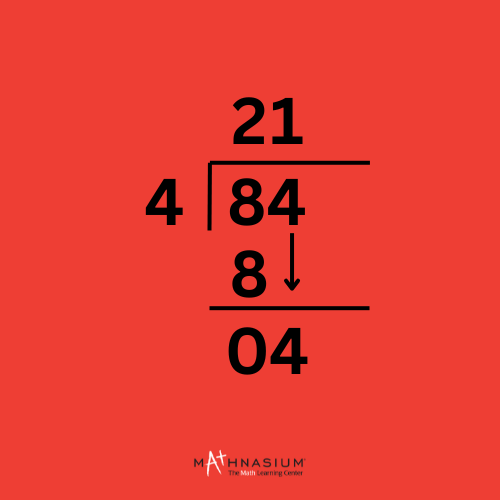
Step 7: Multiply Again
Now, multiply 1 × 4 = 4 and write it under the 4.
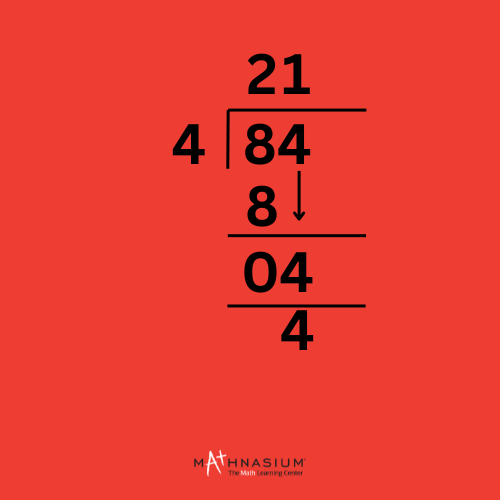
Step 8: Subtract Again
- Subtract 4 - 4 = 0.
- Since there are no digits left to bring down, we are done!
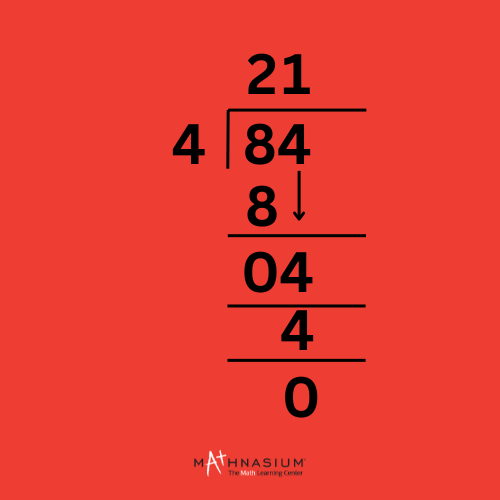
So, using long division, we found that the quotient is 21.
84 ÷ 4 = 21
Use multiplication facts to solve simple division problems quickly. Use long division for bigger numbers, breaking the problem into smaller steps. The more division problems we solve, the faster and more confident we’ll become.
Your Turn! Practice Finding These Quotients
Time to practice what you've learned. See if you can find these quotients.
-
35 ÷ 5 = ?
-
81 ÷ 9 = ?
-
63 ÷ 3 = ?
-
144 ÷ 12 = ?
-
225 ÷ 5 = ?
-
56 ÷ 3 = ?
-
100 ÷ 7 = ?
-
99 ÷ 4 = ?
-
250 ÷ 12 = ?
-
125 ÷ 8 = ?
When you’re finished, check your answers at the bottom of the guide.
FAQs About Quotients
1. How do I check if my quotient is correct?
You can check your answer by multiplying the quotient by the divisor. If your answer is correct, you should get back to the original dividend.
2. What’s the difference between a quotient and a remainder?
A quotient is the answer we get when we divide one number by another, while a remainder is what’s left over when the numbers don’t divide evenly.
3. Can a quotient be a decimal?
Yes! If a number doesn’t divide evenly, we can keep dividing to get a decimal quotient instead of a remainder. For example, 10 ÷ 4 = 2.5 instead of 2 R2. Decimals are useful when working with money, measurements, or anything that needs to be divided exactly.
4. What’s the difference between a remainder and a decimal quotient?
A remainder shows what’s left over after dividing, while a decimal quotient keeps dividing to give an exact answer.
Master the Quotient at Mathnasium of Parker
Mathnasium of Parker is a math-only learning center in Colorado for K-12 students of all skill levels.
Our specially trained math tutors offer personalized instruction and online support to help students truly understand and enjoy any math topic including the quotient.
Discover our approach to elementary school tutoring:
Whether your student is looking to catch up, keep up, or get ahead in their math class, schedule an assessment, and enroll at Mathnasium of Parker today!
Schedule a Free Assessment at Mathnasium of Parker
Pssst! Check Your Answers Here
If you’ve given our practice exercises a try, check your answers below:
-
35 ÷ 5 = 7
-
81 ÷ 9 = 9
-
63 ÷ 3 = 21
-
144 ÷ 12 = 12
-
225 ÷ 5 = 45
-
56 ÷ 3 = 18 R2 (18 remainder 2)
-
100 ÷ 7 = 14 R2 (14 remainder 2) or 14.28 (decimal quotient)
-
99 ÷ 4 = 24 R3 (24 remainder 3) or 24.75 (decimal quotient)
-
250 ÷ 12 = 20 R10 (20 remainder 10) or 20.83 (decimal quotient)
-
125 ÷ 8 = 15 R5 (15 remainder 5) or 15.625 (decimal quotient)


 (303) 840-1184
 (303) 840-1184