












A deviation from the horizontal. An inclined line.
The slope of a line describes how steep it is and in which direction it tilts. It measures how much a line rises or falls as it moves from left to right, comparing vertical change to horizontal change.
Slope is often described as "rise over run":
Slope = Rise ÷ Run = (change in y) ÷ (change in x)
For example, a line that rises 2 units for every 3 units it runs to the right has a slope of 2/3.
Slope can point in different directions:
-
Positive slope: the line rises from left to right
-
Negative slope: the line falls from left to right
-
Zero slope: the line is perfectly horizontal, with no rise at all
-
Undefined slope: the line is perfectly vertical, with no run at all
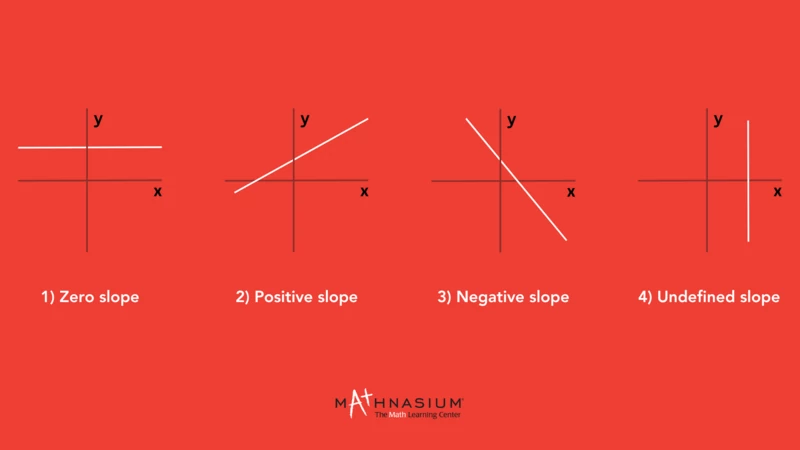
Slope connects directly to direction of change and rate of change: a steeper slope means a faster rate of increase or decrease, while a slope near zero means the line is nearly flat.
When Do Students Learn About Slope?
Students build toward slope through their early work with number lines and graphing points.
Grades 3–5 – Graphing Points and Lines
Students plot points on a coordinate grid and begin noticing how lines tilt, laying the groundwork for slope.
Grades 6–8 – Calculating and Interpreting Slope
Students formally calculate slope using rise over run, connect it to unit rate, and use it to describe linear relationships.
Grades 9+ – Slope in Advanced Algebra and Geometry
Students use slope in equations of lines, to test for parallel and perpendicular lines, and in calculus as a foundation for rates of change.