5 Math Skills Kids Learn From Solving a Rubik’s Cube
Nov 18, 2025
| Tuckahoe
At Mathnasium, we believe students learn best when math feels both empowering and tangible. That’s why our learning environments often include hands-on tools and games that help students explore math in a way they can see and touch.
One of those tools is the Rubik’s Cube, a colorful, familiar puzzle that kids encounter sooner or later.
But what might surprise parents is just how much mathematical thinking goes into solving it. Far from being just a fun brain teaser, the cube is packed with opportunities to develop real, transferable math skills.
Today, our tutors explain what math skills solving a Rubik’s Cube can build and why this classic puzzle belongs alongside foundational tools for learning geometry, logic, and problem-solving.
1. Recognizing Patterns
Hand a student a Rubik’s Cube and watch their eyes. What do you see?
Almost immediately, they start searching for patterns such as rows of matching colors, mirrored sides, or repeating corner pieces.
As they begin turning and twisting, they quickly learn that solving the cube depends on understanding how those patterns change and reappear.
We’ve seen that when students notice patterns on a Rubik’s Cube, they’re doing what strong math thinkers do: looking for structure, testing ideas, and learning to predict what comes next.
In early grades, this shows up when kids skip count, learn their multiplication facts, or figure out number sequences. It's all groundwork for algebra.
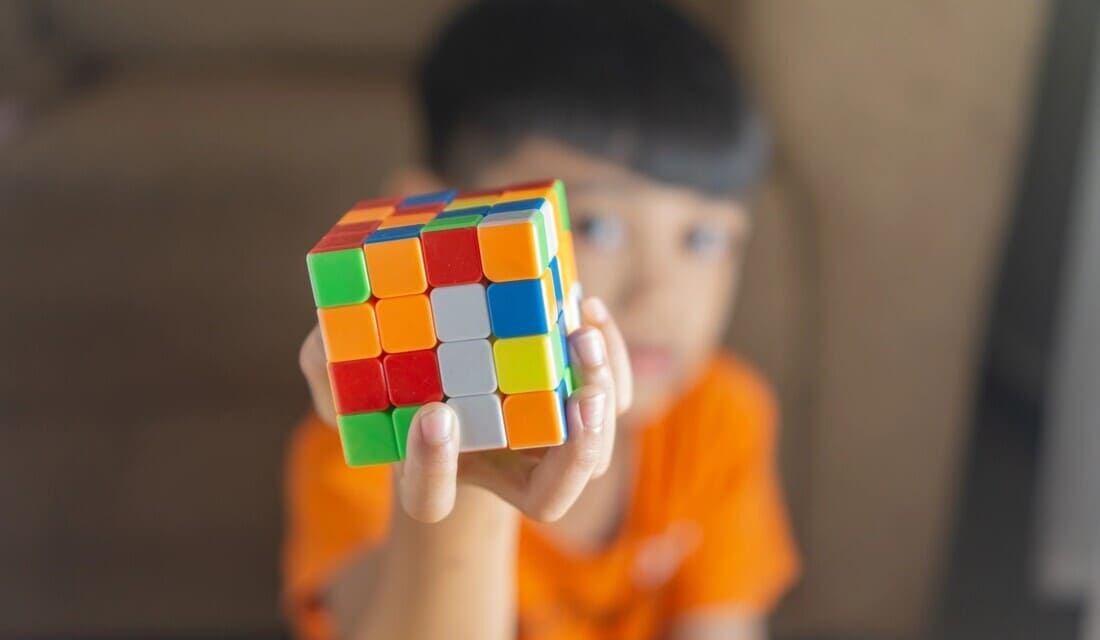
Students begin solving the Rubik’s Cube by spotting patterns, an early step toward structured thinking in math.
2. Building Spatial Visualization
Solving a Rubik's Cube trains your child’s brain to think in three dimensions (3D). They start to visualize how one twist affects the whole puzzle, even without looking at it.
This skill of mentally rotating objects is exactly what helps students excel in geometry and visual problem-solving.
And research backs this up.
A recent study measured spatial reasoning in students who solve the Rubik’s Cube regularly. On average, they scored 72.74%, compared to 56.63% for students with no cube experience. Impressive, right?
The same research found that faster solvers also tended to have stronger spatial skills overall.
We see this progress unfold at our centers.
At first, students watch every move they make. But pretty soon, they start seeing the solution in their head before their hands even move.
They’re thinking a few steps ahead, predicting what’ll happen next. And that same skill? It carries into their math, particularly in graphing, geometry, and multi-step visual problems.
Before the cube starts to make sense, students usually hit a wall. Random twists stop working, and patterns fall apart. That’s when they learn to follow sequences of moves, known as algorithms, in a specific order.
If they miss a step or reverse the order, the cube doesn’t solve. It resets, or worse, scrambles further. So they begin thinking carefully before acting, checking each move against the one that came before.
That’s the same kind of step-based reasoning students use in math. Whether they’re solving equations, working through long division, or following a multi-step word problem, the logic is procedural. Each step depends on the last, and one mistake can throw everything off.
We hear it in the questions they begin to ask: “What happens if I do this?” or “Will this undo the last move?” That’s cause-and-effect thinking, and it’s a hallmark of strong mathematical reasoning.
At Mathnasium, we build this kind of logic gradually, through guided practice that builds one step at a time. As students develop confidence, they stop guessing and start planning, because they understand how each part of the process connects.
Very few people solve a Rubik’s Cube on the first try, unless you’re one of those rare prodigies like Max Park, who can do it in under four seconds.
For most students, there’s experimenting, backtracking, or undoing what looked like progress. But each attempt teaches something new, and eventually, the effort begins to pay off.
This is where perseverance takes root. Students learn that improvement doesn’t come from luck or shortcuts but from sticking with the problem. And that lesson matters in math just as much as it does on the cube.
Psychologist Carol Dweck of Stanford University calls this a growth mindset, the belief that ability develops through effort, not talent alone. Her research shows that students who embrace struggle and stay with a task are more likely to succeed long-term, even when the material gets harder.
All the more reason we often recommend the Rubik’s Cube to parents of students. It gives kids a chance to wrestle with something challenging in a way that feels approachable, and that sort of persistence carries into the classroom.
🎥 Watch Max Park set the Rubik’s Cube world record.
5. Discovering Advanced Math Ideas
Last but not least, spending time with a Rubik’s Cube gives kids a quiet introduction to advanced math ideas they may not even realize they’re using.
Here’s what’s happening behind the scenes:
Permutations: Every twist of the cube changes the order of the pieces. Figuring out how to return them to the right spots is all about understanding how different combinations work. That’s called permutation, and it’s a concept used in higher-level math and even computer science.
Symmetry: The cube has a built-in structure. When students learn to solve one side, they start noticing that certain moves have a “mirror” effect. That’s symmetry. It’s the same idea used in geometry and pattern recognition.
Systems and rules: The Rubik’s Cube isn’t random. Every move is part of a system. In math, this kind of structure is studied in something called group theory. We don’t expect students (or parents) to know the term, but they’re already working within that system when they learn that certain sequences undo others or return pieces to their original place.
We mathematicians call that ability to think beyond the numbers “abstraction.” It’s one of the most powerful habits a math student can build, and the Rubik’s Cube gets them there in a way that feels more like curiosity than coursework.
How Mathnasium Makes Math Fun and Engaging for Everyone
Both research and our experience show that when students approach math in a low-pressure setting, like working on a Rubik’s Cube, they’re more willing to engage and even enjoy the process.
That philosophy is at the heart of Mathnasium.
Our goal is simple: make math make sense for each student. We do that through our proprietary teaching approach, called the Mathnasium Method™.
It starts with a diagnostic assessment. Think of it as a window into what your child already knows, where they need support, and how they learn best, whether that’s visually, verbally, or through hands-on tools like puzzles, manipulatives, and yes, the Rubik’s Cube.
From there, we build a personalized learning plan tailored to your child’s needs, whether they’re building foundational skills, tackling current schoolwork, or pushing into advanced concepts.
Once the plan is in place, our tutors work face-to-face with students in an environment designed to be engaging, interactive, and confidence-building. They don’t just show how to get the answer, they explain the why behind each method, helping students build the critical thinking and problem-solving skills they’ll use in math and beyond.
Our sessions often include games, hands-on challenges, and built-in rewards to keep students motivated and focused.
And the results speak for themselves:
94% of parents report improvement in their child’s math skills and understanding
93% of parents say their child’s attitude toward math improved after joining Mathnasium
90% of students saw better grades in school
Whether your child needs to catch up, keep up, or get ahead, your local Mathnasium center is ready to help them succeed with a personalized path that makes math click.
Visit Us at Mathnasium of Tuckahoe
Mathnasium of Tuckahoe is a math-only learning center for K-12 students in Richmond,
VA. Trusted by over a million parents, Mathnasium uses personalized learning plans
and the proprietary Mathnasium Method™ to help students catch up, keep up, and get ahead on their math journey.
Our specially trained tutors deliver face-to-face instruction in a supportive and fun small-group environment,
working with students to develop a deep understanding of math, build confidence,
and improve academic performance.
Solid middle school math skills build the reasoning students need for SAT® success. Learn how to support your child early, at home, and with Mathnasium.
Learn how to spot key readiness skills for multiplication and support your child with insights based on national math standards and real classroom experience.
Our team had a phenomenal time at the Henrico County Rubik's Cube Tournament. We loved seeing so much enthusiasm for problem-solving—both with numbers and cubes!


 (804) 282-3805